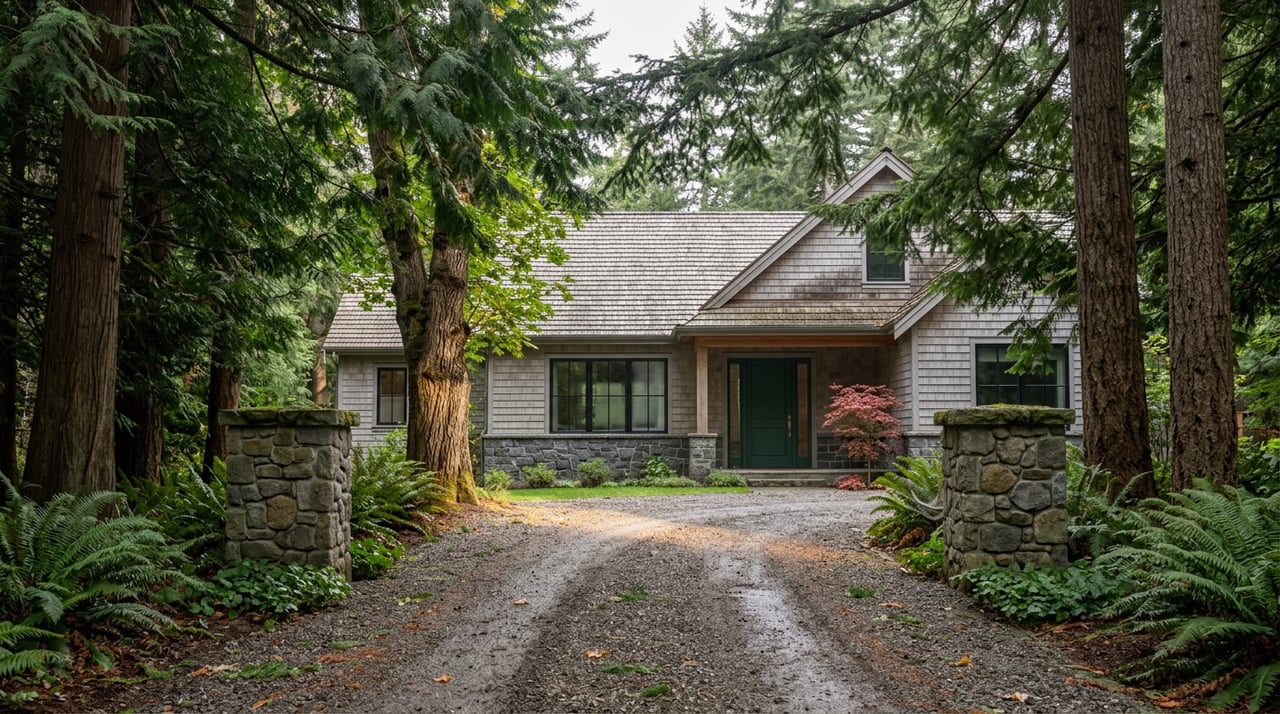
Ask anyone who has tried to buy waterfront on Bainbridge Island's north end what they remember about the listing, and they will describe the view first. Puget Sound, Mount Rainier on a clear day, maybe a sailboat idling toward the Port Madison Yacht Club, a satellite of the Seattle Yacht Club that has anchored the inner harbor's social life for generations. What they rarely mention, until their title company calls, is the driveway.
Two homes in the Redfin-defined Port Madison neighborhood closed within eight weeks of each other this year. A three-bedroom on Sunrise Drive NE sold April 17, 2026 for $1,248,000, its full asking price, after 35 days on market. A two-bedroom on Point Monroe Drive NE sold June 9, 2026 for $1,370,000, a full 8% under its $1,495,000 list price, after 41 days on the market. Both are in the same MLS neighborhood boundary. Both are waterfront. The gap between them is not explained by square footage or bathroom count. It is explained by something buyers rarely think to ask about until they are already in escrow: how the property is legally accessed and where its wastewater goes.
A Mill Town That Never Got Repaved
Port Madison's roads look the way they do because the neighborhood is older than the concept of a subdivision plat. The community traces back to the 1850s, when the Port Madison Mill Company ran one of the largest sawmills on Puget Sound, complete with a general store, a school, and a post office. When the lumber economy declined, the land didn't get replatted into a modern grid of dedicated public streets. It got carved up piecemeal, parcel by parcel, family by family, often with access granted through recorded easements across a neighbor's land rather than a city-maintained right-of-way.
That history is still legally active today. A road easement recorded decades ago does not expire just because the neighborhood turned into some of the most valuable real estate in Kitsap County. It sits in the chain of title, waiting for a new owner's title company to find it, and it usually comes bundled with a maintenance agreement that spells out who plows the gravel, who pays for regrading after a wet winter, and what happens if one of the parties on the agreement stops paying their share.
The City of Bainbridge Island has spent real money trying to smooth over the north end's access problems at the margins. In 2024 the city completed two roundabouts, one at the intersection of SR 305 and NE West Port Madison Road and NE Seabold Road, the other at SR 305 and NE Adas Will Lane, specifically to improve access to the neighborhoods up here. That fixed the public arterial. It did nothing for the private lane a quarter mile past the roundabout that a handful of households still share and maintain among themselves.
What a Road Dispute Actually Looks Like Here
Road and easement disagreements on the island's northeast side are not hypothetical. A 2021 dispute reported by the Bainbridge Island Review escalated to a full city council vote after a property owner sought to use an existing county-owned access strip to reach land, over the objections of neighbors who had maintained that same access under their own road agreement with the county for decades and paid for its upkeep out of pocket. One side of the standoff described the setting plainly:
"It's real private out there. They can't even see my house."
The city ultimately voted to buy the disputed strip for $23,352 to resolve the standoff, and a councilmember asked staff to draft a general policy so it wouldn't have to referee the next one from scratch. That case didn't happen inside Port Madison's boundary, but the underlying mechanism is the same one buyers up here run into: a driveway that predates zoning code, a decades-old agreement between neighbors rather than the city, and a chain of title that reads differently than the way everyone has actually behaved for years.
Septic Is the Rule, Not the Exception
Sewer service never reached most of the island's north end, and Port Madison is no exception. A recent listing for a buildable lot on Lafayette Avenue, wedged between historic Port Madison and the driftwood beaches of Fay Bainbridge Park, advertised an existing two-bedroom septic system with water and electricity available in the street, meaning the utility corridor stops at the property line and the wastewater question starts there.
That has real timeline consequences. A septic system needs a current operations and maintenance certificate, and if a buyer wants to add a bedroom or convert that guest studio over the garage into a rental, the septic design has to support it before the county will sign off. Waterfront lots on well-drained soil sometimes handle this cleanly. Lots with shallow groundwater or a small footprint sometimes require a full new drainfield design, which adds weeks that a sewer-served neighborhood buyer never has to plan for.
The Comps, Side by Side
| Address | Sold | List Price | Sale Price | Sale-to-List | Days on Market |
|---|---|---|---|---|---|
| Sunrise Dr NE | April 17, 2026 | $1,248,000 | $1,248,000 | At list | 35 |
| Point Monroe Dr NE | June 9, 2026 | $1,495,000 | $1,370,000 | 8% under | 41 |
A third sale in the same window, a $905,000 close in late May 2026, rounds out the range and shows how wide the pricing spread runs inside a single MLS-defined neighborhood in the same season. None of that spread shows up if you only look at the median. It shows up when you ask what backs the driveway and where the tank sits.
The pattern that shows up again and again in this micro-market is simple: listings with a clean, single public-street address and documented utility hookups tend to move at or near list price in five to six weeks. Listings where a buyer's agent has to chase down a decades-old recorded easement, confirm a septic certificate, or clarify who is actually party to a private road maintenance agreement tend to sit longer and close softer, because every extra week of due diligence is a week a buyer's financing commitment can wobble.
Conservation Easements Are the Other Layer
Port Madison and the surrounding north end also sit inside the working territory of the Bainbridge Island Land Trust, which currently holds 48 conservation easements across the island, 42 of them on private land. These are not zoning restrictions the city can waive. A conservation easement is a permanent, recorded agreement between a landowner and the Land Trust that limits what can be built or cleared on a defined portion of the parcel, and it survives every future sale. The Land Trust's own portfolio includes a 3.44-acre easement protecting a sand spit and wetland near Agate Passage and a 3.2-acre family homestead easement covering a backshore wetland, both examples of the kind of shoreline restriction a north-end buyer can inherit without ever having negotiated it themselves.
Waterfront buyers also need to understand road ends. The city maintains more than 60 public road ends across the island specifically to preserve shoreline access, protected under state law (RCW 35.79.035) from being quietly closed off. If a Port Madison listing sits near one of these road ends, the "private" beach in the listing photos may have a narrow strip of public access running directly through or alongside it.
Before You Write an Offer
If you are looking seriously at a Port Madison listing, ask your agent to pull these documents before your offer goes in, not after:
- The recorded road maintenance agreement, if the parcel is served by a private road, including who the current signatories are and what the annual assessment has actually been
- A current septic operations and maintenance certificate, plus the design capacity if you plan to add bedrooms or a detached living space
- A full title report checking specifically for recorded conservation easements, not just standard utility easements
- Confirmation of whether the parcel sits adjacent to a city road end and what public access rights run through the property
- Any history of assessments, disputes, or unresolved maintenance costs tied to a shared driveway or easement
Frequently Asked Questions
Does every home in Port Madison rely on a private road? No. Some parcels front directly on public streets. The mix is exactly the point, and it is why two listings a few hundred yards apart can have very different closing timelines.
Is a private road automatically a problem? Not automatically. Plenty of private road arrangements in Port Madison have run smoothly for decades with clear, well-funded maintenance agreements. The risk is buying without reading the agreement first.
How do I find out if a specific home has a septic system or sewer? The county health department keeps permitted septic system records by parcel, and your agent or title company can pull this alongside the standard title search.
Port Madison rewards buyers who read past the listing photo. The view is real. So is the paperwork underneath it. If you are circling a specific address up here, or thinking about what your own Port Madison property is actually worth once its road and septic situation are factored in, contact your Island Life Concierge at the Amy McFarland Team before you write or accept an offer, not after.