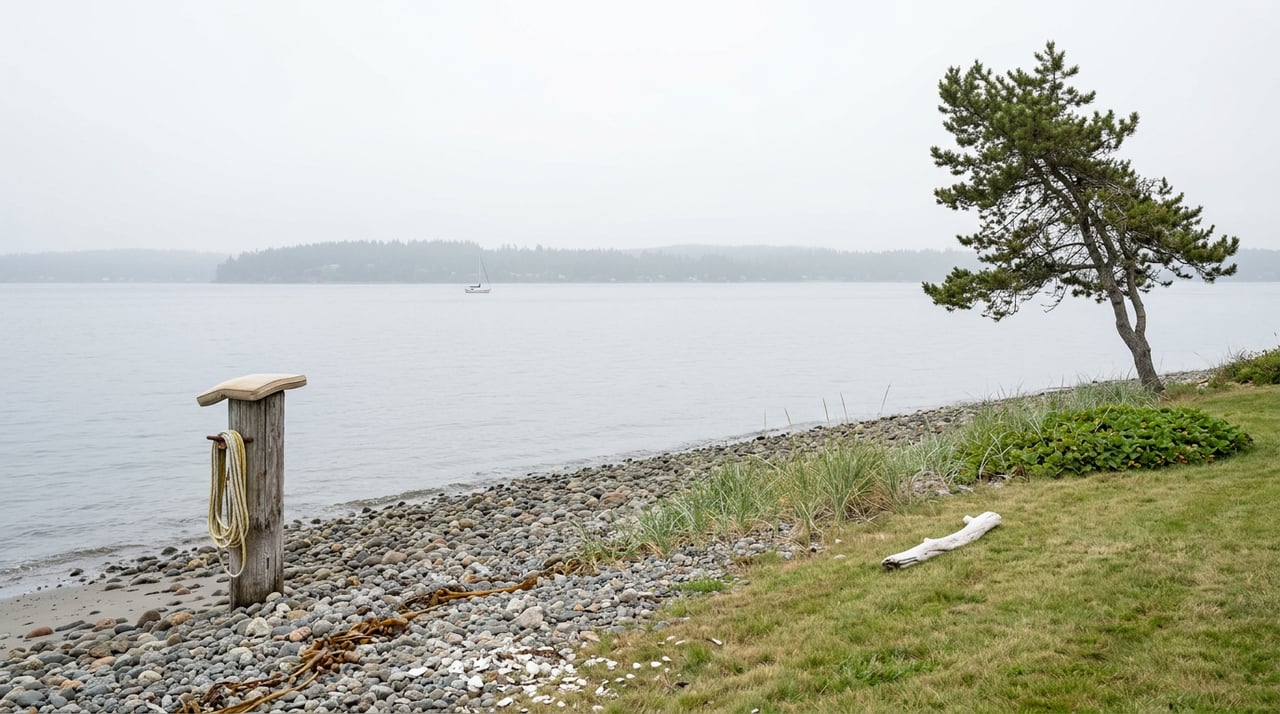
Most buyers picture a private dock when they imagine waterfront property on Bainbridge Island's South Beach. Walk the shoreline along South Beach Drive and neighboring Beans Bight and you'll find something different: mooring buoys bobbing offshore, low-bank beach access, and very few permitted docks at all. It's a detail that surprises out-of-area buyers on their first showing, and it changes how a seller should describe the property and how a buyer should plan for boat storage.
The same disconnect shows up when an aging bulkhead needs attention. Homeowners tend to treat a bulkhead repair the way they'd treat a fence or a roof, something a contractor can just handle. On the stretch of Rich Passage that fronts South Beach, the City of Bainbridge Island's own shoreline rules say otherwise. Even fixing a wall that's already there requires a filing with the city, not simply a phone call to a marine contractor.
What "Repair" Actually Means Under the City's Shoreline Rules
Bainbridge Island administers its own Shoreline Master Program, separate from the Kitsap County version that covers Poulsbo, Bremerton, and unincorporated Kitsap. Chapter 16.12 of the Bainbridge Island Municipal Code spells out that the program applies to development within 200 feet of the ordinary high water mark and reaches out to the midline of the surrounding marine waters, named specifically as Puget Sound, Port Madison, Agate Pass, Port Orchard, and Rich Passage. That last one is South Beach's shoreline.
The code carries a grandfather clause: anything lawfully built before November 26, 1996, isn't required to meet current standards unless the owner proposes a change. That protects a lot of older bulkheads and boathouses on lots that have been in the same family for decades. But "unless a change is proposed" is doing real work in that sentence. The city's residential permitting guidance draws a clear line for docks: building a new one calls for a full shoreline permit, while modifying, repairing, or replacing one that already exists calls for a shoreline exemption filing instead.
The same logic extends to bulkheads and other shoreline armoring, which the city's land use code lists separately as requiring their own shoreline substantial development exemption filing. Repair isn't automatically simpler than new construction. It's a different filing with its own review. For a seller, that means a bulkhead that's been "fine for thirty years" can still trigger a city review the moment it's touched, whether that touch comes from the seller before listing or the buyer after closing.
Why There's No Dock to Point To
South Beach and the adjacent Beans Bight enclave sit on the island's south shore facing Rich Passage, with south-facing exposure that gives residents unobstructed views toward Mount Rainier and, on clear days, glimpses of the Seattle skyline. The waterfront here runs predominantly low-bank, which makes beach access easy but doesn't come with the deep water that private docks typically require. Most homeowners moor to buoys instead. For buyers who want to launch a larger boat, the practical answer is Fort Ward Park, a 137-acre public park just minutes away with its own boat launch and more than 4,000 feet of saltwater shoreline.
That's a meaningful detail to get right in a listing description and in early buyer conversations. Describing a home as having dock access when the reality is a mooring buoy sets up a mismatch that surfaces during a walkthrough, not before an offer.
The Number That Doesn't Match the Headline
Bainbridge Island's waterfront segment tells a story that looks, at first glance, like unstoppable strength. The median waterfront sale price on the island reached an all-time high of $2,668,000 in 2024, up from the previous record of $2,575,000 set in 2023. Waterfront property makes up only about 18.5 percent of the island's overall housing market, yet its continued appreciation has offset declines in the non-waterfront segment, where median prices fell in both 2023 and 2024.
Here's the part that doesn't fit the hot-market narrative:
| Year | Median Waterfront Sale Price | Waterfront Sales |
|---|---|---|
| 2023 | $2,575,000 | not reported |
| 2024 | $2,668,000 (record) | 62 |
| 2025 | not reported | 52 (down 16% YoY) |
Prices went up while the number of sales went down. That's not a market getting hotter. It's a market getting thinner. Fewer waterfront owners are choosing to sell, and the ones who do are commanding record prices partly because there's less inventory to compare them against.
That scarcity matters for pricing strategy. In a segment where roughly 50 sales happen across the entire island in a given year, one property with an unusual bulkhead condition, a missing permit, or a septic system near the end of its life can move the comps more than it would in a faster, larger pool. Over the three months ending April 2026, the median sale price across all Bainbridge Island homes stood at $1.1 million, down 18.8 percent year over year, with homes going under contract in an average of eight days. The broader market cooled. Waterfront pulled the other way. A South Beach seller needs to know which of those two markets their property actually belongs to before setting a price.
What a Bulkhead Actually Costs to Fix, or Remove
Bainbridge Island shorelines are more armored than most people assume. More than half of the island's waterfront is lined with bulkheads, rock walls, or similar structures, many of them decades old. The Bainbridge Island Land Trust's Powel Shoreline Restoration Project, on the island's north end in Port Madison, offers a real benchmark. When that property's owners faced a failing bulkhead, replacing it in kind was estimated at roughly $300 per linear foot, which for their extensive shoreline totaled more than $500,000 including debris removal. They chose restoration instead, removing more than a third of a mile of old bulkhead and letting the beach return to something closer to its natural state.
That $300-per-foot figure scales differently depending on lot size, but it's a useful gut check for any South Beach seller staring down an aging wall. A 100-foot bulkhead replaced in kind, using that same benchmark, lands in the tens of thousands of dollars before engineering and permitting costs are added. The city's own code has a quiet incentive built in for owners who choose restoration over reinforcement: property owners who remove a bulkhead and restore natural shoreline can receive mitigation credit toward a future development project if that restoration happened within the prior ten years. For a seller weighing whether to fix an old wall before listing or simply disclose its condition and price accordingly, that's worth a conversation with a shoreline permitting specialist before a shovel goes in the ground. Locally, permitting specialists such as Leann Ebe have built practices around walking island sellers through exactly this decision.
Septic, Not Sewer, and Why the Timeline Matters
Like much of the island's south end, South Beach runs largely on individual septic systems rather than municipal sewer. Septic systems on Bainbridge Island fall under the jurisdiction of Kitsap Public Health District, and a septic inspection is a standard part of a buyer's due diligence alongside any bulkhead or dock history.
With island homes going under contract in an average of eight days over the three months ending April 2026, there isn't much runway to discover a septic or shoreline issue after an offer arrives. Sellers who order a septic inspection and pull shoreline permit history before listing, rather than after an accepted offer, tend to keep their closing timeline intact instead of renegotiating mid-escrow. This is exactly the kind of preparation the team folds into pre-listing planning, including where Compass Concierge funding can cover the cost of inspections and minor repairs ahead of going live.
Before You List, Four Things Worth Checking
- Pull the permit history for any bulkhead, dock, or shoreline structure through the city's permit portal, and confirm what predates the 1996 grandfather cutoff versus what's been modified since.
- Schedule a septic inspection through a Kitsap Public Health District licensed provider well ahead of listing, not after an offer arrives.
- If the bulkhead is original or aging, get a marine engineer's opinion on condition before deciding whether to repair, restore, or simply disclose and price accordingly.
- Check the listing language against reality: buoy versus dock, low-bank versus bulkheaded, and any moorage arrangement that isn't a permitted structure.
South Beach waterfront rewards a buyer who wants sun, beach access, and quiet water on Rich Passage. It asks a seller to be precise about what's actually there: a buoy instead of a dock, a bulkhead that's aged past its original permit, a septic system with its own inspection clock. None of that makes the property less desirable. It makes the transaction move faster when the seller already has the answers a shoreline-savvy buyer is going to ask for.
The Amy McFarland Team has walked South Beach sellers through exactly this kind of preparation, from coordinating a pre-listing septic inspection to bringing in a marine engineer before a bulkhead becomes a negotiation point. Explore the team's waterfront expertise or contact your Island Life Concierge for a walkthrough of what your specific shoreline history means for pricing and timeline.
Frequently Asked Questions
Does every South Beach waterfront home have a private dock? No. Most of the waterfront along South Beach and Beans Bight is low-bank without permitted docks, and buoy moorage is far more common. Fort Ward Park's public boat launch is the nearby option for anything requiring deeper water.
Can I build a new dock if my South Beach property doesn't have one? It's possible, but it requires a full shoreline permit through the City of Bainbridge Island, a separate and more involved process than the exemption filing used for repairing or replacing an existing dock.
Is an older bulkhead automatically compliant because it's been there for decades? Only until it's changed. Bulkheads built before November 26, 1996, are generally grandfathered under the city's Shoreline Master Program, but repairing, replacing, or otherwise altering that structure triggers a review under current rules.